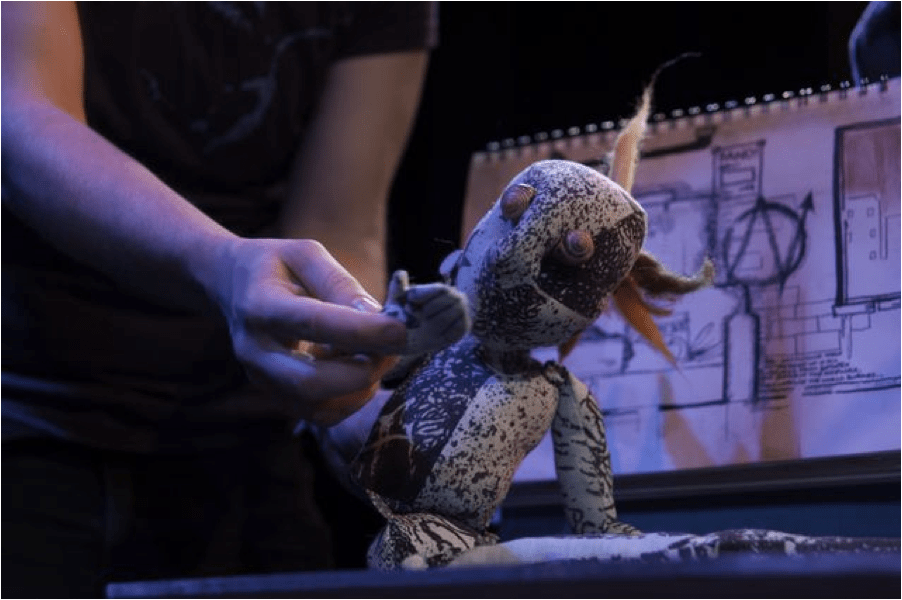
“Lazy Harry and Fat Trina” – developed 2012
Lazy Harry and Fat Trina was created as a laboratory intensive under the PLX (Puppetry eXploratory Lab) tutelage of Ann and David Powell, the aim of which is to practice devised theatre with strangers. For three months, we worked from a little known Brothers Grimm story as assigned by David. The main theme is time, how to find enough of it, and also young friendship. Our show takes an affectionate, good humored view towards work-dodging, as does the original. The laboratory did not complete the script and the show existed as a presentation of excerpts for discussion with peers at Fresh Idea in Puppetry.
I designed the show with Carmen Gillespie. The table-top puppets are based on a design of Ann’s, adapted by myself and Gillespie. We choose to portray the story using current-era punk kids. This puppet, Lazy Harry, is very gangly limbed, compared to his companion Fat Trina, whose body is stronger and larger with a hole through her middle that she is always trying to fill with food. She is sassy and not ashamed that eating and “being fat” are a part of her. They are table-top puppet made from a couple of shirts found abandoned in a squat. The character has snail-shell eyes from the Don Valley. These shells and the narrator who is a snail speak to the theme of the story, which is preferring a slowing of life. Harry’s hair and ear-plugs were removable, to show when the character was becoming a punk.
Ideally, it was performed outdoors. The audience of 12 – 24 people sit in the central space, in a spiral, having been ushered there to start: At the start of the show, they grasp a blue string attached to the narrator – a snail – and follow the snail into a spiral, then sit. During the show, the snail is passed along the string with each scene change and is “eaten” by Fat Trina in the end. The puppets perform in front of two sketch-books, representing Trina and Harry’s sketch-books and thus their inner world and connection to each other. These sketchbooks are turned to change the scene. Bug Cruickshank drew the sketchbook backgrounds for this presentation. The scenes were performed on a small table that revolved around the audience, like a clock (there are 12 scenes): The table is picked up and shuffled by hand.
 Grey Muldoon Art